Concrete is one of the most common materials in Houston’s built environment from residential driveways, patios, and foundation slabs to the massive industrial floors of the region’s manufacturing and petrochemical facilities, to commercial parking lots and tilt-wall building panels. When concrete reaches the end of its useful life, needs to be replaced, or must be removed to accommodate new development, Concrete Demolition And Removal Houston is the process that gets it out. This guide examines what that process involves in the Houston context and how it is performed across the full range of project types common in the Greater Houston area.
Why Concrete Is Removed in Houston
Houston’s climate and soil conditions create distinctive concrete deterioration mechanisms. The region receives roughly 50 inches of annual rainfall one of the highest averages among major U.S. cities and that rainfall drives persistent moisture in the expansive clay subsoil. The clay’s cycle of swelling when wet and contracting when dry applies variable forces to concrete slabs. Over time, this movement causes slabs to crack, develop differential settlement, and become uneven and structurally compromised.
Post-flood concrete damage is a Houston-specific consideration. Major flooding events can undermine the soil beneath concrete slabs, causing them to settle, crack, and lose structural support. Homes in repeatedly flooded areas face concrete slab removal as part of the teardown and elevated rebuild process following flood damage. Redevelopment is another major driver older commercial properties are regularly cleared for higher-density uses, and each project requires comprehensive concrete demolition and removal as part of site clearance.
Methods of Concrete Demolition
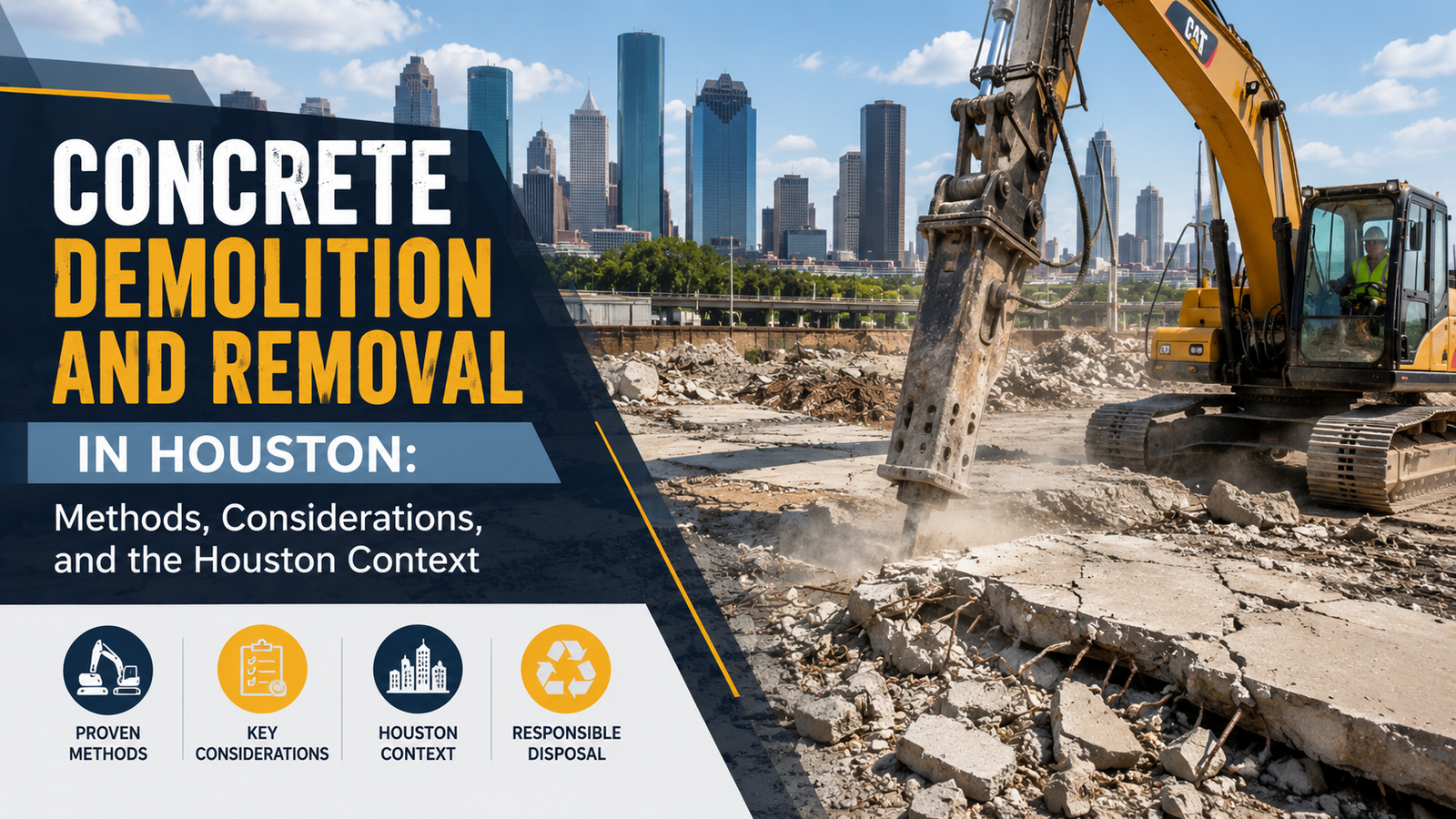
Hydraulic breaking is the workhorse method for concrete demolition across Houston. Excavators equipped with hydraulic breaker attachments fracture concrete through repeated high-energy impact blows, breaking the slab into pieces that can be grabbed, loaded, and hauled. Breaker size is matched to concrete thickness and reinforcement residential driveways and patios (typically 4 to 6 inches thick) require smaller breakers than industrial floors (which may be 8 to 12 inches or more) or tilt-wall panels.
Concrete sawing is used when a clean, straight cut is required removing a section of driveway while leaving adjacent concrete intact, making utility penetrations through slabs, or creating control joint lines. Diamond-blade walk-behind saws and track saws produce precise cuts without disturbing adjacent material. Core drilling creates circular penetrations through concrete for new utility installations. For Houston’s petrochemical and industrial sector, some concrete demolition involves post-tensioned concrete which contains high-tension steel cables under stress requiring careful management during demolition to prevent dangerous energy release.
Reinforcement and Recycling in Houston
Most concrete in Houston construction contains steel reinforcement rebar or welded wire mesh that significantly affects the demolition process. Reinforced concrete breaks into large, connected pieces held together by the steel, requiring manual or mechanical separation. Workers use bolt cutters, angle grinders, or hydraulic shears to sever rebar as sections are broken apart.
Concrete recycling is well-established in the Houston market. Crushed concrete aggregate (RCA) is widely used as base material for road construction, parking lots, driveways, and fill applications throughout Harris County and surrounding areas. Houston’s active infrastructure construction creates steady demand for recycled aggregate. Steel rebar recovered during concrete demolition is separately recycled through scrap metal channels, providing economic offset to the overall project.
Common Houston Concrete Demolition Projects
Residential concrete removal in Houston commonly involves driveways, patios, pool decks, sidewalks, and foundation slabs. Pool removal is a significant sub-category the region’s hot climate has resulted in a high per-capita pool ownership rate, and older pools that have deteriorated or whose space is wanted for other uses are removed through concrete breaking and excavation. Commercial concrete demolition encompasses parking lots, loading docks, tilt-wall panels, and building slabs.
Common Questions About Concrete Demolition in Houston
Do I need a permit to remove my concrete driveway in Houston? Permit requirements for residential concrete removal depend on scope and location. Replacing a driveway or patio typically requires a concrete permit. Confirm with the City of Houston or Harris County permitting authorities for your specific project.
How long does concrete demolition take? Project duration depends on the quantity of concrete, thickness, reinforcement, and access conditions. A typical Houston residential driveway might be demolished and removed in a few hours to a full day. Large commercial or industrial scopes can take days or weeks depending on volume and complexity.