
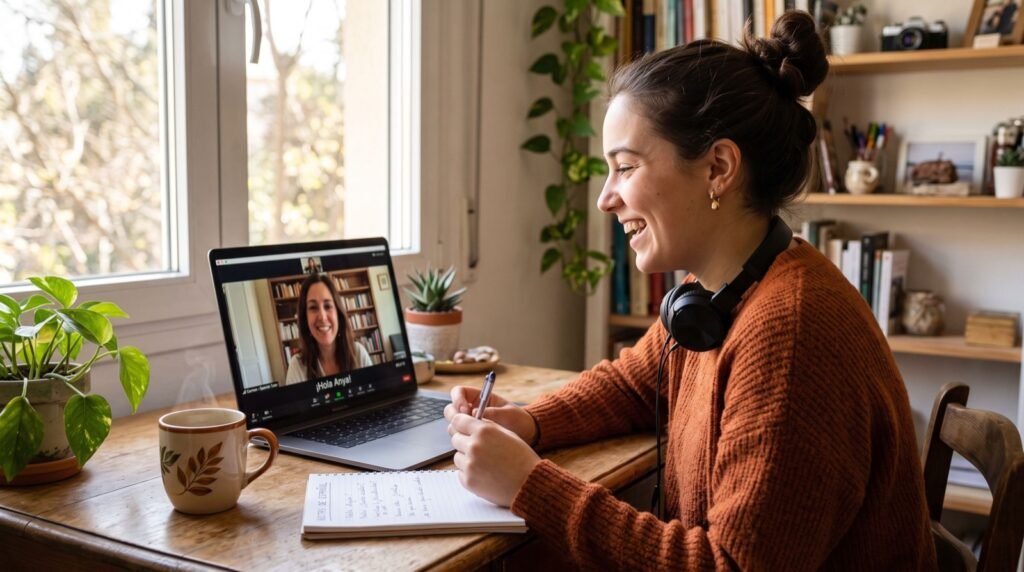
Learning a new language online is more accessible than ever in 2026, but access alone does not create fluency. Thousands of learners download an app, practise for two weeks, and quietly give up. This guide reveals what separates the people who actually become conversational from those who stall at “hello.”
Why Traditional Language Learning Stalls
Most learners treat language like a subject to memorise rather than a skill to perform. They collect vocabulary lists and grammar rules but rarely speak. The result is a large passive knowledge base and near-zero ability to hold a conversation.
Decades of research summarised by the American Council on the Teaching of Foreign Languages point to the same conclusion: real communication practice drives proficiency. You cannot read your way to fluency any more than you can read your way to swimming.
How Can You Learn a Language Faster Online?
Speed comes from focusing on the right activities in the right order. The most efficient learners front-load speaking and listening rather than saving them for “when they are ready.”
- Learn the 500 most common words first; they cover most everyday conversation.
- Start speaking in week one, even if it is clumsy and slow.
- Listen daily to native content at your level to train your ear.
- Review mistakes deliberately instead of avoiding the hard sounds.
Many learners accelerate by choosing to learn languages online with a live instructor who corrects pronunciation in real time. That instant feedback loop prevents bad habits from hardening.
The 80/20 of Vocabulary
A small core of high-frequency words does most of the heavy lifting in daily conversation. Prioritise those, and you can understand a surprising amount long before you have “finished” a course. Chasing rare vocabulary early is a common trap that slows real progress.
Comparing the Main Learning Methods
Each approach has a place. The table below shows where each one shines so you can build a smart combination.
| Method | Strength | Weakness |
|---|---|---|
| Language apps | Great for daily vocabulary drills | Weak on real conversation |
| Live online tutoring | Real speaking + instant correction | Costs more than apps |
| Immersion content | Trains listening and culture | Overwhelming for beginners |
| Language exchange | Free, authentic practice | Quality varies widely |
The winning formula for most people blends an app for daily reps, immersion content for the ear, and a tutor for structured speaking practice. No single tool does it all.
Building a Daily Language Habit
Fluency is a compounding habit, not a one-time event. Small consistent exposure beats occasional intense study every time.
- Anchor it: attach practice to an existing habit like morning coffee.
- Speak out loud: even solo shadowing of audio builds the mouth muscles you need.
- Think in the language: narrate simple daily actions to yourself.
- Track streaks: a visible chain of study days is quietly motivating.
Consistency turns a foreign language from an intimidating mountain into a series of small, walkable steps.
When a Tutor Accelerates Everything
Apps are patient but silent; they never tell you why your accent sounds off. A tutor closes that gap. For learners who also need broader academic support, providers offering the best tutors in Islamabad pair language coaching with exam and subject help under one roof, which keeps everything coordinated.
Vet any tutor the way you would choose trusted professionals for anything that matters. Ask about their teaching experience, request a trial lesson, and confirm they can adapt to your level and goals.
Overcoming the Fear of Speaking
The biggest barrier to fluency is rarely ability; it is the fear of sounding foolish. Learners rehearse endlessly in their heads yet freeze the moment a real conversation starts. Breaking that fear early is the single most important thing you can do in 2026.
Reframe mistakes as data, not failures. Every fumbled sentence teaches your brain something a flawless silent rehearsal never could. Native speakers are almost always encouraging toward learners who try, and the imagined judgement is far harsher than the real thing.
Start speaking in low-stakes settings before high-stakes ones. Talk to yourself, describe your surroundings aloud, or record short voice notes. By the time you sit down with a tutor or a native speaker, your mouth already knows the shapes of the words.
- Shadow audio: repeat sentences aloud immediately after hearing them.
- Narrate your day: describe simple actions in the target language.
- Record yourself: hearing your own voice reveals fixable habits.
- Embrace the pause: silence while you think is normal, not failure.
Using Immersion Without Leaving Home
You no longer need to travel abroad to immerse yourself in a language. In 2026, immersion is a setting you can build around your daily life with the devices already in your pocket. The trick is consistency and comprehensible input.
Switch your phone or a favourite app into the target language so you encounter it constantly in a familiar context. Watch shows you already know with subtitles in the language you are learning, since the plot you remember gives you clues to the new words.
Listen during dead time. Commutes, chores, and workouts become free practice when filled with podcasts or music at your level. This kind of steady, low-effort exposure trains your ear far more effectively than an occasional intense study session, and it costs you no extra time at all.
Aim for comprehensible input, meaning content you understand roughly 80 percent of. Material that is too easy bores you, while material that is too hard becomes noise your brain tunes out. That sweet spot, where you follow the gist but meet a few new words each time, is where listening ability grows fastest.
Layer reading on top of listening whenever you can. Following a transcript while you listen connects sound to spelling and reinforces both channels at once. Over a few months, this simple pairing quietly builds the intuition that native speakers take for granted, and it requires no expensive tools to start.
Frequently Asked Questions
How long does it take to become conversational?
With daily practice and regular speaking, many learners reach basic conversation in three to six months. Cumulative languages and irregular practice extend that timeline considerably.
Are language apps enough on their own?
Apps build vocabulary and consistency well, but they rarely produce confident speakers alone. Pairing an app with live conversation practice fills the gap they leave.
Should I focus on grammar or speaking first?
Lead with speaking and high-frequency vocabulary, then layer grammar in as you notice patterns. Learners who chase perfect grammar first tend to freeze when they finally try to talk.
How often should I practise?
Short daily sessions of 20 to 30 minutes outperform long weekly ones. Languages reward frequent exposure because your brain consolidates them a little each day.
Conclusion
Becoming fluent in 2026 is less about the perfect app and more about speaking early, practising daily, and getting real feedback. Blend the tools, build the habit, and add a tutor when you are ready to accelerate. Do that and you will move from memorising phrases to holding real conversations. Ready to start? Book a trial lesson, open your app, and begin your language journey today.


